
Press brake tooling lasts longest and sets up fastest when every punch and die has a clean, dry, labelled home — stored by type, protected from rust, and placed as close as possible to the brake. In practice that means choosing between a mobile tooling trolley (flexible, machine-side) and a stationary tooling cabinet (high-density, enclosed), then running a simple clean → dry → oil → store → inspect routine after every job. Tranyond sells working examples of both approaches, and this guide shows you exactly how to use them.
Why press brake tooling storage deserves a system
Press brake punches and dies are precision-ground components. A single dropped die or a corroded V-opening can mean scrapped parts, re-ground tooling, and weeks of downtime waiting for a replacement. Poor storage also costs time even when nothing breaks: fabricators routinely lose setup minutes hunting for the right die, and shops that keep organized tooling close to the machine cut tool location and loading time on every job change.
- Tooling is the second-most expensive consumable in a bending shop — treating it like hardware bin stock guarantees damage.
- Setup time is the hidden tax — every minute spent searching for a die is a minute the brake is not making parts.
- Safety is at stake — loose punches stacked on a bench or leaning against a rack can fall on operators or get knocked into the machine.
Five ways press brake tooling gets damaged or lost between jobs
Most tooling damage happens between jobs, not during bending. The usual culprits:
- Rust from moisture — damp shop air and hand moisture etch precision-ground faces within days; wooden storage racks are a notorious promoter because wood holds and slowly releases moisture.
- Contamination — metal chips, scale, and old lubricant left on a die get pressed into the next part's surface and into the die's own radius.
- Nicked edges from loose stacking — punches and dies thrown together edge-to-edge chip each other; a nicked V-die shoulder transfers a line onto every bend it makes.
- Corrosion from bare metal contact — dissimilar metals stored touching each other can accelerate surface corrosion in humid climates.
- Chaos and mislabelling — mixed tool styles and missing V-opening labels force operators to "make do" with the wrong die, which overworks the tooling and degrades part quality.
Rust prevention starts before storage: clean, dry, oil
Storage equipment cannot fix dirty tooling. Follow this order every time a tool leaves the machine:
- Clean — wipe off chips, scale, and lubricant residue with a lint-free cloth and solvent.
- Dry completely — trapped moisture under a protective coating is worse than none.
- Protect — apply a light film of rust-preventive oil to precision-ground faces before longer storage.
- Store — place the tool in its dedicated slot or row, never loose in a drawer.
- Inspect — check edges and radii for nicks each time you return or retrieve a tool; catch damage while it is still repairable.
Keep storage away from humidifiers, wash bays, and exterior doors. If your climate is humid, add a desiccant or shop heater near the cabinet — the goal is to keep tooling surfaces above the dew point.
Mobile trolley vs stationary cabinet: which storage system fits your shop
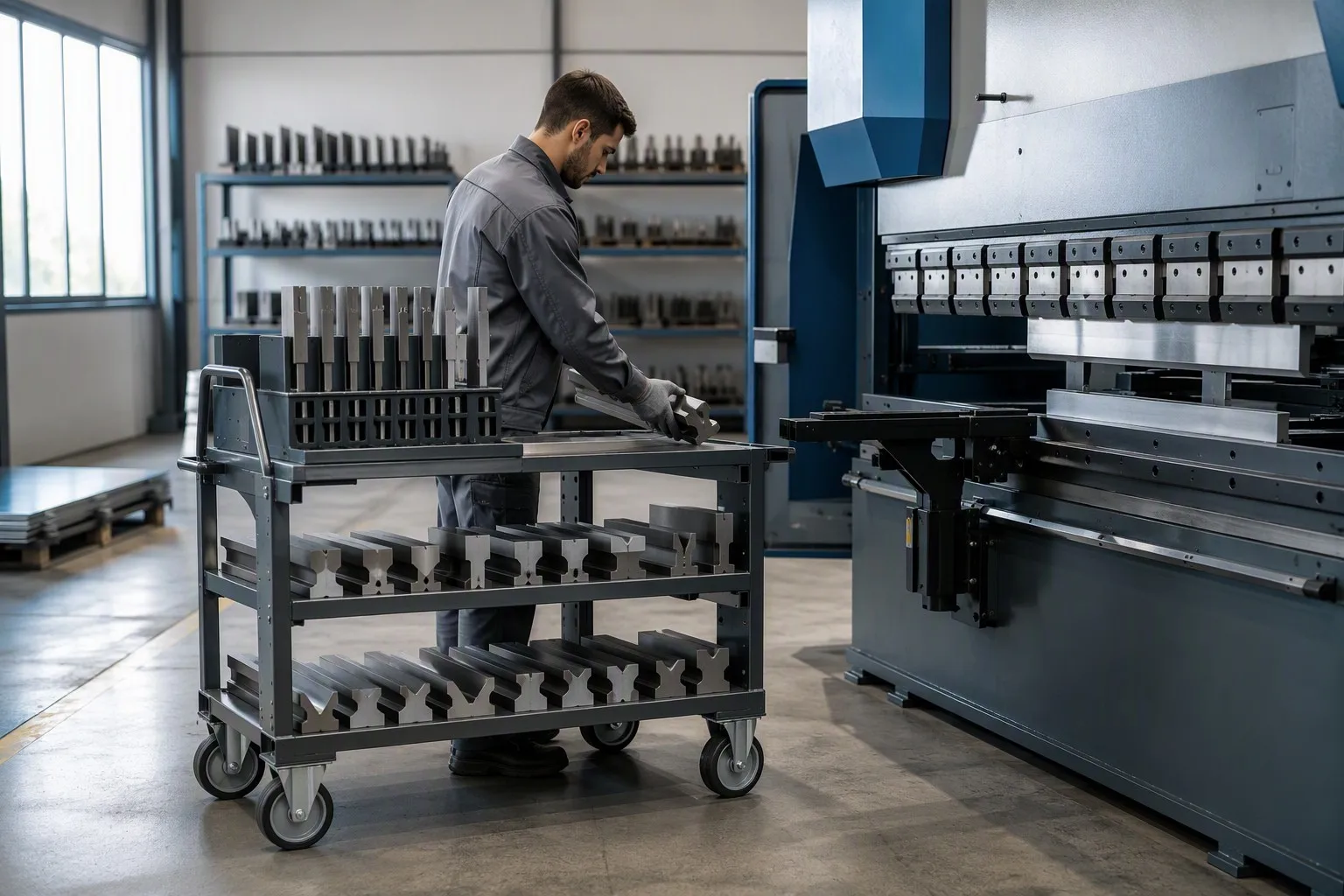
Two real, price-transparent options from Tranyond show the trade-off clearly. A mobile press brake tooling storage trolley (US$999, compare-at US$1,599) is designed to move with the work: it takes up less floor space than a fixed rack, can be repositioned next to whichever brake is running, and suits shops with several machines or frequent layout changes. A CNC bending tooling cabinet (US$1,099, compare-at US$1,999) is a high-density, enclosed station for tooling that stays put: cold-rolled steel outside, stainless steel shelves inside, built for Promecam, Amada and European-style tooling.
| Feature | Mobile tooling trolley | CNC tooling cabinet |
|---|---|---|
| Best for | Shops with several brakes or changing layouts | One main brake with a large regular tool set |
| Mobility | Wheeled; park it next to the active brake | Stationary; set once near the machine |
| Dimensions (L×W×H) | 1100 × 860 × 550 mm | 900 × 500 × 1366 mm |
| Capacity | Open trays for a full working set | Upper punch: 21 rows; lower die: 18 rows (0.6 m² inside) |
| Protection | Open design; oil and cover tooling | Enclosed cold-rolled steel body, stainless shelves |
| Unit weight | ≈65 kg | Net 125 kg |
| Price (USD) | 999 (compare-at 1,599) | 1,099 (compare-at 1,999) |
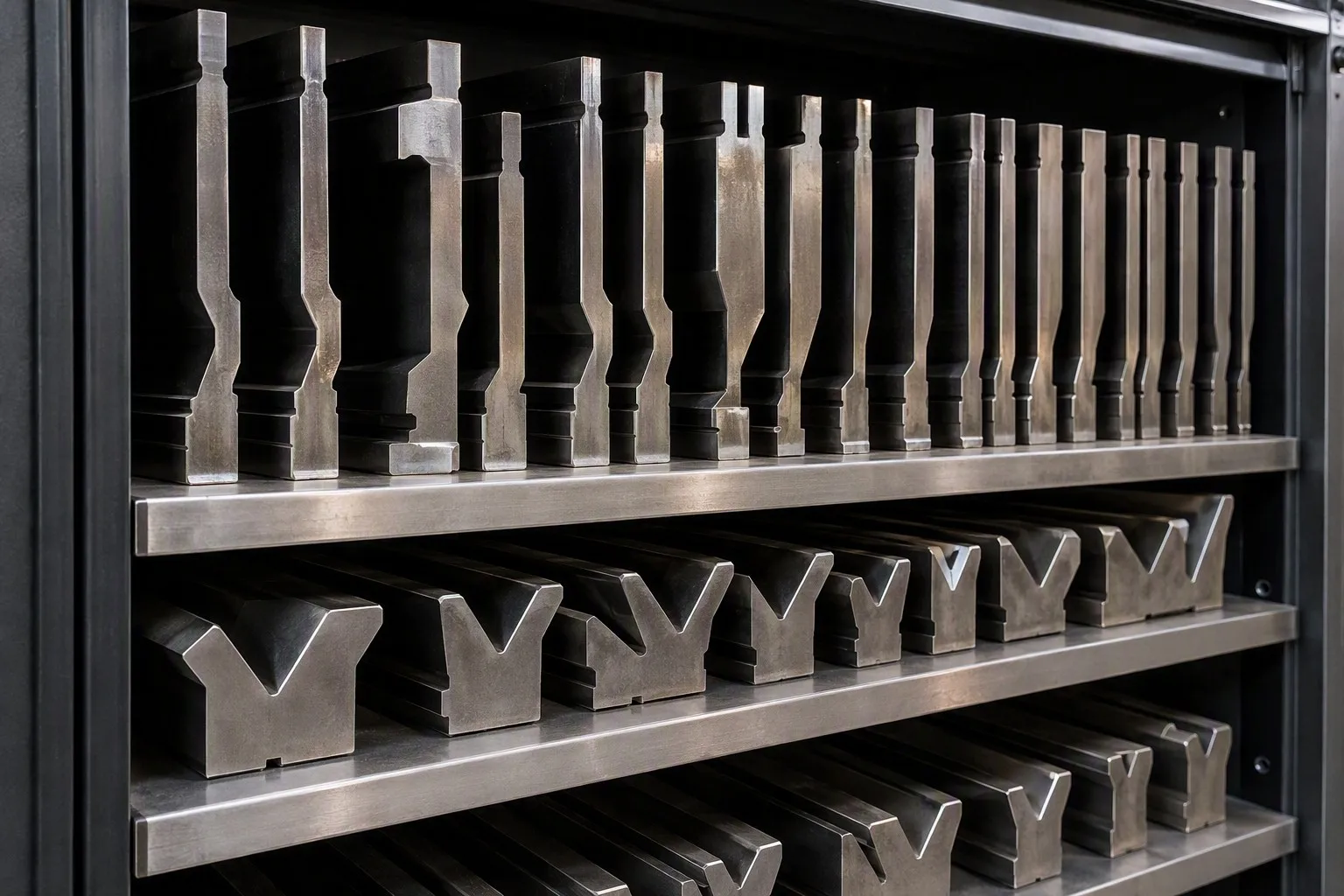
Rule of thumb: if a die is used on one machine all day, it belongs in the cabinet next to that machine. If your shop runs multiple brakes or re-arranges cells often, a mobile trolley pays for itself in saved walking and setup time.
How to organize tooling: separate punches from dies, keep labels visible
Density only helps if you can find things. Use the cabinet's row structure the way it was designed:
- Punches above, dies below — the cabinet's 21 punch rows and 18 die rows match how operators reach: tall thin punches on top, heavy V-dies on lower stainless shelves.
- Group by profile and V-opening — keep 85° punches together and sort V-dies by opening width so the right tool is the first one you see.
- Keep style groups separate — Amada, Promecam and European-style tooling have different shank geometries; mixing them in one row is how wrong tools end up clamped into the machine.
- Label rows, not just tools — a cabinet or trolley with row labels turns a five-minute search into a five-second one.
Move heavy tooling safely: lifting aids that protect both you and the die
Long punch segments and heavy V-dies are awkward to carry and easy to drop. Two habits make a real difference: never carry more than one long tool at a time, and use a lifting aid for anything heavy. Tranyond's magnetic hand lifter for metal parts (US$88, compare-at US$199) lifts up to 30 kg, is heat-resistant, and lets one operator move a die segment with a controlled grip instead of a fingertip pinch — a low-cost ergonomics upgrade for any bending cell.
FAQ
Should press brake dies be stored in wooden racks?
No. Wood absorbs and slowly releases moisture, which keeps tooling damp and promotes rust. Fabricators who built wooden storage units have reported exactly this problem; steel or plastic-lined storage with dry conditions is the safer choice.
Do I need to oil press brake tooling before storage?
For tooling that will sit for more than a shift, yes — a light film of rust-preventive oil on precision-ground faces stops surface rust, especially in humid shops. Wipe the tool clean before the next use.
How many tools fit in a press brake tooling cabinet?
A typical CNC tooling cabinet sized like Tranyond's (900 × 500 × 1366 mm, 0.6 m² inside) holds up to 21 rows of upper punches and 18 rows of lower dies — enough for a full regular production set for one brake.
Can one storage system serve several press brakes?
Yes, if it is mobile. A wheeled tooling trolley can be repositioned beside whichever brake is running, which is why fabricators with multiple machines often keep one trolley per work cell rather than one distant central rack.
Which tooling fits a Promecam / Amada / European-style cabinet?
Those three names describe the shank and clamping geometry of the tooling. Cabinets such as Tranyond's are built to accept Promecam, Amada and European-style punches and dies — check your tool shank type before buying inserts or rows.
Where should the storage unit sit in the workshop?
As close as practical to the press brake, clear of aisles and wash areas. Industry guidance is consistent: tooling placed near the machine shortens tool location and loading time, while storage near moisture sources shortens tool life.
How often should I inspect stored tooling?
At minimum, inspect every tool when it returns to storage and again when it is picked for the next job. Add a monthly audit of stored tooling in humid seasons — catch rust or nicks early, when a light clean or local grind still restores the tool.
Sources
- The Fabricator — "The wisdom of press brake tooling organization" (Aug 31, 2019)
- The Fabricator — "6 ways to boost press brake productivity" (Oct 12, 2015)
- Canadian Metalworking — "How to properly maintain press brake tooling" (Oct 16, 2019)
- The Fabricator — "Where is your press brake tooling?" (Oct 30, 2014)