
If your shop bends short parts up to 400 mm and you want real hydraulic power without a full-size press brake, the Tranyond compact hydraulic press brake — available in 2-ton, 3-ton and 5-ton versions at USD 1,800, USD 2,000 and USD 2,400 — is a bench-friendly machine that runs on single-phase 220 V power. This guide covers the full specifications, how to choose the right tonnage for your parts, the tooling options that ship with or fit the machine, and the safety standards that apply no matter how small the brake is.
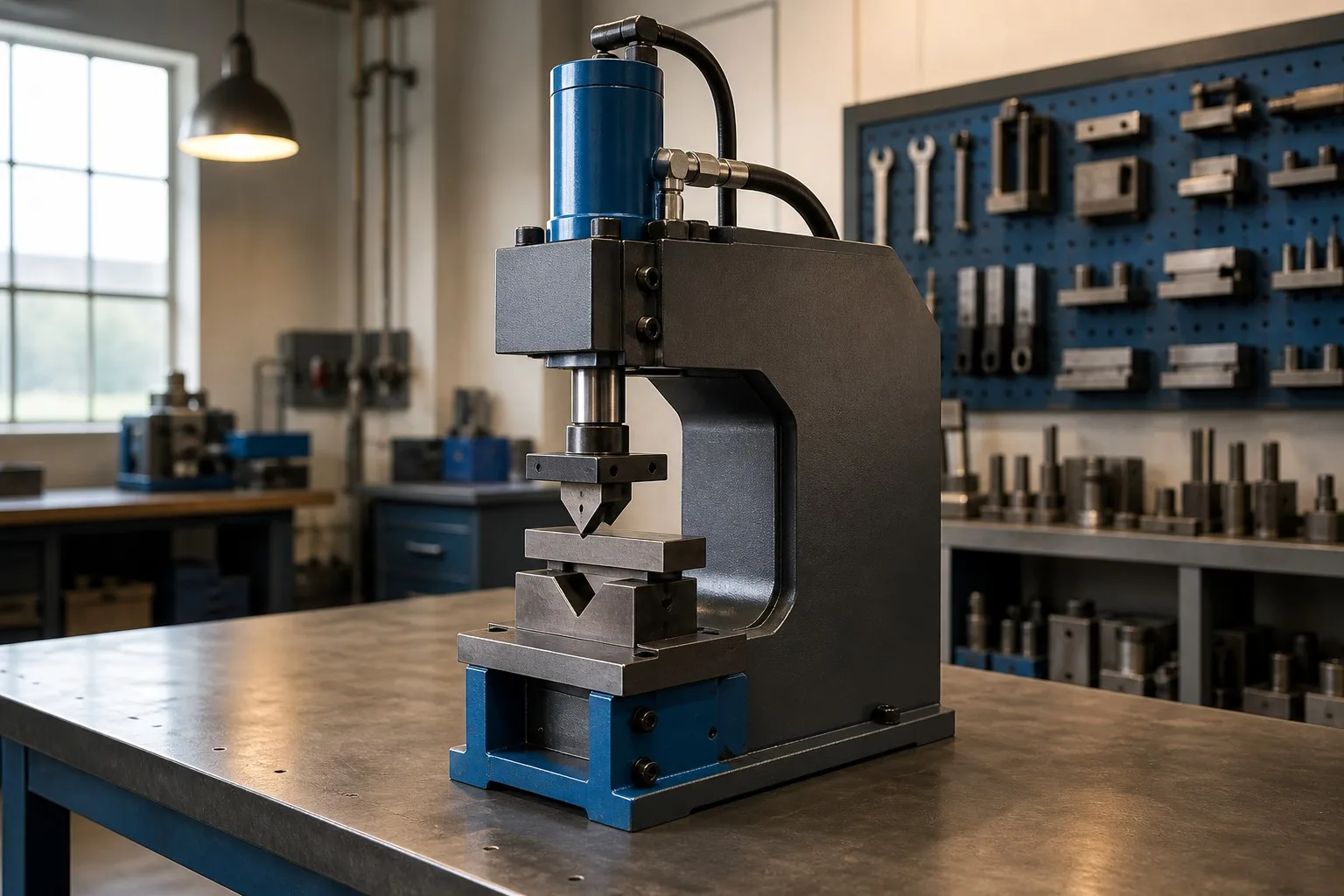
What Is the Tranyond Compact Hydraulic Press Brake?
The Hydraulic press brake compact is a small-frame hydraulic bending machine built for shops, workshops and maintenance departments that bend short workpieces but do not need — or have space for — a full-size CNC brake. It is a complete package: the standard lower die (V8/V12) is included, and the machine is designed to work with two optional tooling sets sold by Tranyond: a V16/V24 lower die and a mark-free bending lower die.
Because it is hydraulic rather than manual, it delivers repeatable force across the stroke and runs 35–45 bending cycles per minute — the practical difference between this machine and a lever-operated bender for small production runs.
Full Specifications: What the Machine Actually Offers
| Specification | Value |
|---|---|
| Bending force | 2 / 3 / 5 tons (model options) |
| Max bending length | 400 mm |
| Motor power | 750 W |
| Bending cycles | 35–45 per minute |
| Oil tank | 25 L |
| Power supply | Single-phase 220 V, 50 Hz |
| Dimensions (L × W × H) | 650 × 500 × 1200 mm |
| Weight | 60 kg |
| Included tooling | Standard lower die V8/V12 |
| Optional tooling | V16V24 lower die / mark-free bending lower die |
| List price (2T / 3T / 5T) | USD 1,800 / USD 2,000 / USD 2,400 |
2T, 3T or 5T: How to Choose the Right Tonnage
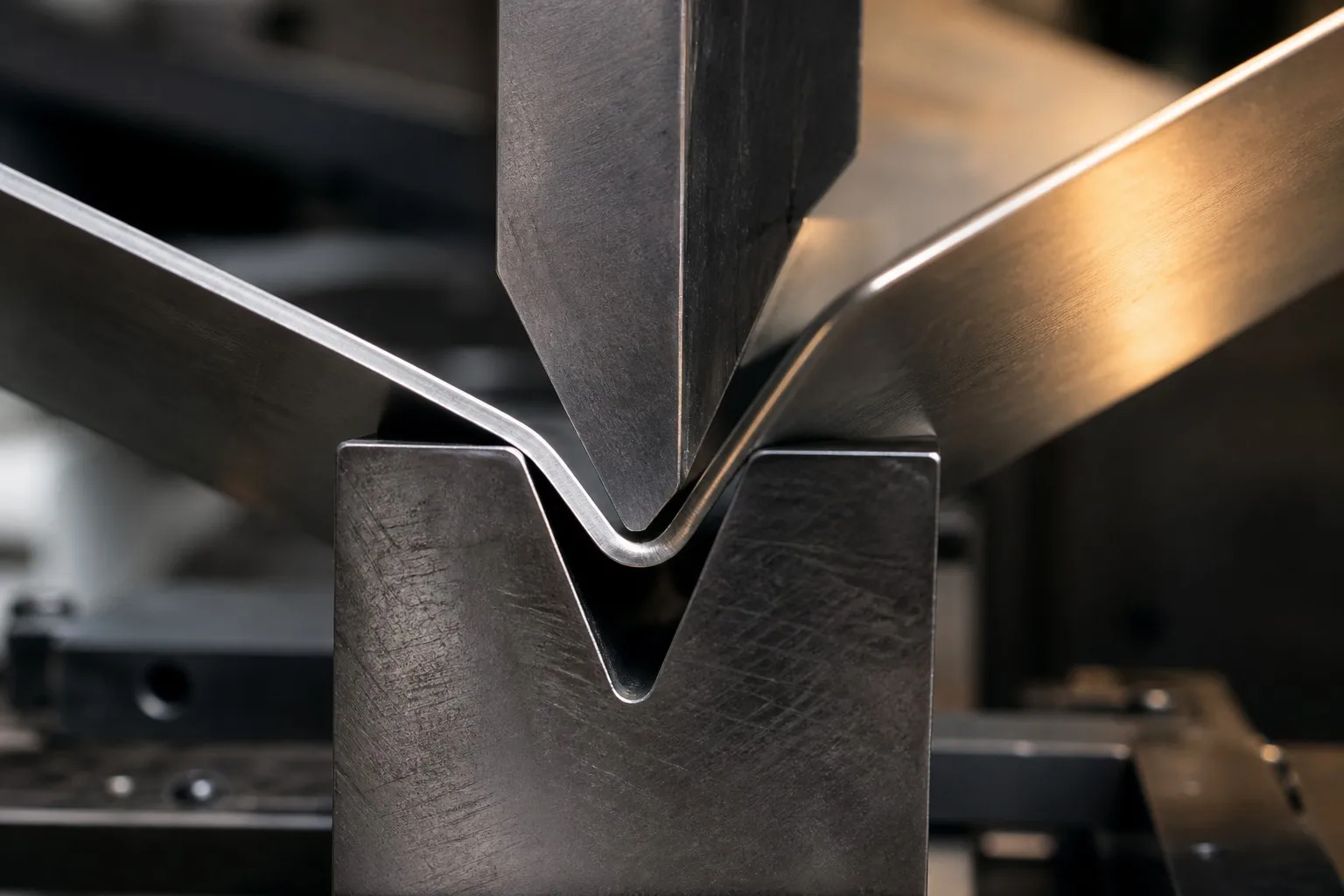
Tonnage is the force the ram can apply, and it decides the thickest material you can bend over a given die opening. The rule of thumb used across the industry is the air-bending formula published by The Fabricator:
Tonnage (tons per foot of bend) ≈ 575 × (material thickness in inches)² ÷ die opening in inches
Three practical steps:
- Measure your longest real bend. The compact machine bends up to 400 mm; if your parts are longer, you need a bigger bed, not more tonnage.
- Match the die opening to the material. A common starting point is a V-opening around 8× the material thickness; a wider V lowers required tonnage but increases the inside radius.
- Pick the next model up if you are near the limit. Bending at the very top of a machine’s rating every day shortens pump and frame life. If a 3-ton calculation sits close to the line, the 5-ton version is the safer buy.
As a sizing example (air bending, mild steel, approximate): a 400 mm long part in 1.0 mm sheet over an 8 mm V-opening needs roughly 3.7 tons (575 × t² ÷ V-opening per foot of bend), which fits the 5T model with margin. Always confirm with the formula for your exact material — stainless and aluminum alloys need different factors than mild steel.
Tooling: V8/V12 Included, V16V24 and Mark-Free as Options
The machine ships with a standard V8/V12 lower die, which covers common small-part bending. Two optional Tranyond tooling sets extend its range:
- V16V24 lower die (USD 100): a wider-opening die set for thicker material and larger inside radii.
- Mark-free bending lower die (USD 300): designed to reduce die marks and surface scratches on pre-finished or stainless workpieces, useful when the visible surface of the part matters.
Because both dies are sold as standalone products, you can add them later without changing the machine — a practical upgrade path as your jobs change.
Where a Compact Hydraulic Press Brake Fits in a Shop
This machine targets a specific gap: jobs that are too heavy for a hand bender or a 1.5-ton table brake, but too short and too infrequent to justify a large CNC brake. Typical uses include:
- Prototype and R&D departments bending brackets and samples up to 400 mm
- Maintenance and repair shops forming replacement parts in steel and stainless
- Small fabrication businesses running short series with repeatable hydraulic force
- Workshops with single-phase power only — no three-phase supply needed
Keep expectations realistic: this is not a replacement for a large press brake. It is a compact hydraulic workhorse for short parts, and its real advantage is the combination of hydraulic repeatability, 400 mm capacity and a price in the USD 1,800–2,400 range.
Safety Still Applies: Standards for Any Press Brake
A smaller machine is not an exempt machine. Press brake operation in the U.S. falls under OSHA’s machine-guarding rules, and OSHA’s eTool on powered press brakes lists presence-sensing devices, two-hand controls, pullbacks and restraints as accepted safeguarding methods. The Fabricator’s overview of press brake safeguarding also points to ANSI B11.3-2012 as the core standard for press brake design and use.
Practical minimums for a compact hydraulic brake:
- Install and keep the guarding supplied with the machine in place
- Keep hands clear of the point of operation during every cycle
- Follow lockout/tagout procedures before oil changes or maintenance
- Train every operator before first use, even on “small” jobs
Frequently Asked Questions
1. How much does the Tranyond compact hydraulic press brake cost?
The 2-ton version lists at USD 1,800, the 3-ton at USD 2,000 and the 5-ton at USD 2,400. The V8/V12 standard lower die is included; optional V16V24 (USD 100) and mark-free lower die (USD 300) tooling is sold separately.
2. What is the maximum bending length?
400 mm. Parts longer than that exceed the bed capacity of this machine regardless of tonnage.
3. What power supply does it need?
Single-phase 220 V, 50 Hz — a standard wall outlet in most workshops, with no three-phase requirement. A 750 W motor drives the hydraulic pump.
4. What tooling comes with the machine?
A standard V8/V12 lower die is included. Tranyond also sells a V16V24 lower die and a mark-free bending lower die as compatible options.
5. What thickness of steel can it bend?
That depends on the tonnage model, die opening and material strength — use the air-bending tonnage formula (575 × thickness² ÷ V-opening, per foot of bend) with your exact material to size the job, and pick the 5T model if you bend regularly near the top of a lower rating.
6. How fast is it?
35–45 bending cycles per minute, which makes short production runs practical compared with manual bending.
7. Is it suitable for a small shop?
Yes — it weighs 60 kg, stands 650 × 500 × 1200 mm, runs on single-phase power and is priced for small shops, prototype departments and maintenance operations. It is not a substitute for a full-size press brake on long or heavy work.
8. Where can I see the full listing?
On the Tranyond store: the Hydraulic press brake compact product page shows the current listing, variants and tooling options.
Sources
- Tranyond — Hydraulic press brake compact product listing (specifications and pricing): tranyond.shop/products/hydraulic-press-brake-compact
- Tranyond — V16V24 lower die: tranyond.shop/products/v16v24-lower-die
- Tranyond — Mark-free bending lower die: tranyond.shop/products/mark-free-bending-lower-die
- OSHA eTool — Machine Guarding: Powered Press Brakes: osha.gov
- The Fabricator — Four steps to calculate press brake tonnage limits (May 18, 2023): thefabricator.com
- The Fabricator — An overview of press brake safeguarding (Nov 28, 2017): thefabricator.com