
Yes — slag (dross) left on laser-cut edges can be removed by hand, and for small shops, prototype work and short runs a dedicated manual remover is often the fastest and lowest-cost fix. If your parts come off the laser with hard beads on the underside or inside holes, this guide explains what slag is, why it forms, how to remove it manually in a few passes, and the exact shop tool Tranyond stocks for the job.
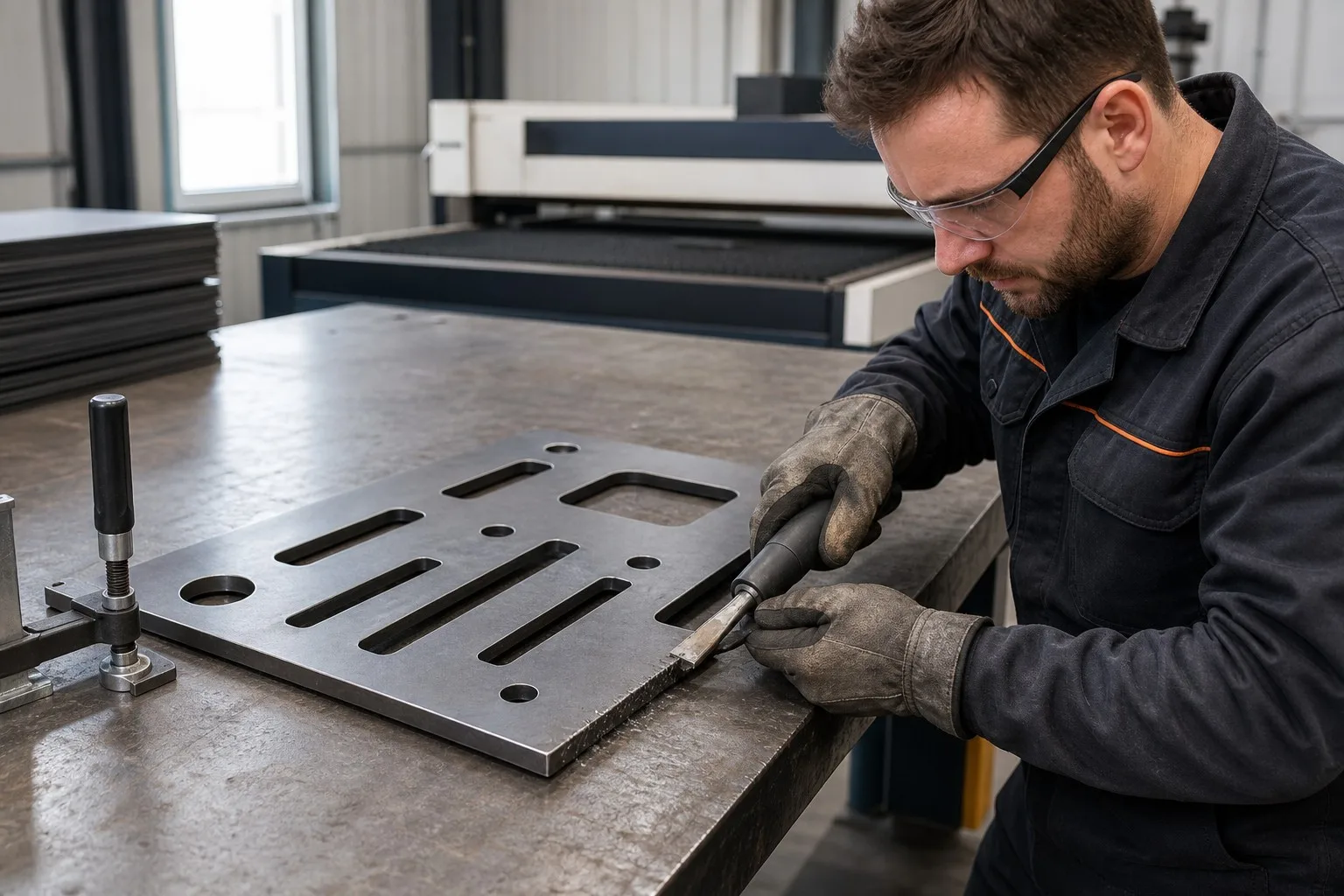
What Is Slag (Dross) on Laser-Cut Parts?
Slag — also called dross — is resolidified molten metal that stays attached to the cut edge after the laser beam passes. During cutting, the assist gas is supposed to blow the molten metal out of the kerf; when the melt cools and hardens before it is fully ejected, it freezes onto the underside of the part as a rough, crusty bead. On oxygen-cut carbon steel it is usually called slag, while nitrogen-cut stainless leaves harder, glass-like dross that is noticeably more difficult to break off.
The Fabricator’s interview with Air Liquide laser expert Charles Caristan describes exactly this mechanism: burrs and dross are created when molten metal — and slag, in oxygen cutting — solidifies faster than the gas flow can evacuate it from the cut. Dross is not just cosmetic. A 2023 study in the peer-reviewed journal Metals (MDPI) showed that dross formation on laser-cut edges measurably reduces the fatigue strength of AISI 304 stainless parts, which makes removal a real quality step for load-bearing components, not an optional tidy-up.
Why Slag Forms: Fix the Cutting Process First
Before you reach for a scraper, check the cutting parameters — most dross can be prevented at the machine. According to the same Fabricator article, common process-side causes include a focus position set too high in the cut (which leaves spiky dross), a dirty or damaged nozzle (which disrupts the gas flow and deflects the shock wave in the kerf), and excessive nozzle standoff (which stops the gas from evacuating the melt cleanly).
Cutting-equipment maker Hypertherm’s cut-quality troubleshooting guide points to the same family of causes: a worn nozzle, excessive cutting speed, or a high standoff is usually behind “too much dross” complaints. A practical prevention checklist:
- Keep the nozzle clean and undamaged — replace it as soon as it shows wear or spatter buildup.
- Set the focus position for the exact material grade and thickness you are cutting.
- Use the correct assist gas pressure — nitrogen cutting typically runs above 150 PSI, while oxygen cutting works at much lower pressure; too low on either leaves dross.
- Do not push cutting speed past what the gas flow can clear — slowing down is often the wrong fix; correcting focus and pressure usually is the right one.
- Maintain a nozzle standoff close to one nozzle diameter.
When dross keeps appearing even on a well-tuned machine, or when you only have a handful of parts to clean, manual removal becomes the practical answer.
Manual Slag Removal: When It Is the Right Call
For one-off parts, prototypes, small batches and thin-gauge work, installing automated deburring equipment is overkill. Deburring machine maker Timesavers notes that dross and slag have traditionally been scraped off metal by hand with a hammer or a knife — effective, but slow and not without risk of injury. A purpose-built handheld remover sits in the middle: faster and safer than an improvised scraper, and inexpensive enough that even a small shop keeps one at the machine bench.
How to Remove Slag by Hand, Step by Step
- Secure the part. Clamp or hold the workpiece firmly on the bench so it cannot shift under pressure.
- Work the bottom edge first. Hold the remover at a low angle and push it along the cut edge so the blade drives the dross away from the part, not into it.
- Clear holes and internal contours. Laser-cut holes and slots collect dross on their walls; pass the remover around each opening before moving on.
- Inspect and repeat. Hard dross on stainless often needs two passes — one to break the crust, one to level the edge.
- Deburr lightly. A final light pass along every edge removes any sharp slivers left by the slag layer.
- Wear protection. Use cut-resistant gloves and safety glasses — scraped dross breaks into sharp, fast-moving fragments.
The Tranyond Manual Slag Remover at a Glance
Tranyond’s Manual laser cutting machine slag remover is a purpose-built handheld tool for exactly this job. It is a manual unit — no power, no setup — sized to clear slag and dross from laser-cut edges, holes and small parts at the bench or directly on the cutting table.
| Specification | Value |
|---|---|
| Product type | Manual handheld slag remover for laser cutting machines |
| Dimensions (L × W × H) | 730 × 140 × 85 mm |
| Weight | 3 kg |
| Operation | Manual — no power supply or air required |
| Typical use | Removing slag and dross from laser-cut edges, holes and small sheet-metal parts |
| Price | USD 298 (current listing price) |
At 3 kg and 730 mm long, the tool is light enough for single-operator bench work and long enough to reach across a full-size sheet. The product page shows the current listing, images and availability — stock is confirmed on the store at the time of writing.

When Manual Is Not Enough: Automated Options
Manual removal is the right default for low volumes, but it does not scale. If you process hundreds of identical parts per day, or if your customers require a consistent deburred finish on every edge, automated methods take over: vibratory tumblers and bowl finishers with ceramic media, brush or grinding machines that remove dross in line with the cutting table (the approach Timesavers describes), or electropolishing for stainless where surface quality matters most.
Use this simple decision rule: a few parts or prototypes → manual remover at the bench; repeatable batches with edge-quality requirements → automated deburring. Most shops need both — and the manual tool is the one that pays for itself first.
Frequently Asked Questions
1. What is slag or dross on laser-cut metal?
Slag (dross) is molten metal that resolidifies on the cut edge before the assist gas can blow it away. It appears as a rough, hard bead on the underside of laser-cut parts — and inside cut holes — and is common on thicker sheets and on stainless steel cut with nitrogen.
2. Can slag be removed from laser-cut parts by hand?
Yes. Manual scraping is a standard method for low volumes: the operator pushes a handheld remover or scraper along the cut edge to break the dross off. Timesavers confirms that manual scraping with a hammer or knife has been the traditional approach, and a purpose-built handheld remover does the job faster and more safely.
3. Why does my laser cut leave dross on the bottom edge?
Usually because of cutting parameters, not the machine itself. The most common causes are a worn or dirty nozzle, a focus position set too high in the cut, excessive cutting speed, incorrect assist gas pressure, or too large a nozzle standoff. Fix those first — prevention is faster than removal.
4. Is bottom-edge dross a real quality problem?
Yes, for many applications. A 2023 study in Metals (MDPI) found that dross on laser-cut edges reduces the fatigue strength of AISI 304 stainless parts, so dross removal matters for load-bearing or repeatedly stressed components — not just for appearance.
5. What safety precautions apply to manual slag removal?
Scraped dross breaks into sharp fragments. Wear cut-resistant gloves and safety glasses, secure the workpiece so it cannot shift, and scrape away from your body. Treat the freshly cut part as sharp-edged — laser-cut edges can cut skin even before dross removal.
6. What are the specifications and price of the Tranyond manual slag remover?
The Tranyond Manual laser cutting machine slag remover measures 730 × 140 × 85 mm, weighs 3 kg, requires no power supply, and lists at USD 298. It is a handheld manual tool for removing slag and dross from laser-cut edges, holes and small parts.
7. When should I automate dross removal instead of doing it by hand?
Automate when volumes are high or the finish must be consistent on every part — for example with vibratory tumblers, brush or grinding machines in line with the cutting table. For prototypes, short runs and occasional cleanup, a manual remover is faster to set up and costs a fraction of automated equipment.
Sources
- Tranyond — Manual laser cutting machine slag remover product listing (specifications and pricing): tranyond.shop/products/manual-laser-cutting-machine-slag-remover
- The Fabricator — Laser cutting basics: The science of burr-free laser cutting (Jan 25, 2017): thefabricator.com
- Timesavers — Dross removal machine for sheet metal (Apr 22, 2021): timesaversint.com
- Hypertherm — Troubleshooting cut quality problems: too much dross: hypertherm.com
- Bach, J. et al. — Influence of the Dross Formation of the Laser-Cut Edge on the Fatigue Strength of AISI 304, Metals 2023, 13(3), 624: mdpi.com (DOI: 10.3390/met13030624)