
Short answer: the TYD-System Amada 85° punch range covers 22 stocked top tools with three tip radii (R0.6, R0.8 and R3 mm), overall heights from 65.45 mm to 165 mm, and rated loads from 120 to 1,000 kN/m — supplied in 835 mm, 415 mm and 800 mm sectionalized lengths. Choose by tip radius first, confirm height against your clamping system second, and check the rated load against the tonnage your bend actually needs before you buy.
If you run a press brake with an Amada-style upper clamping system, this guide lists every SKU in the 85° series with the specifications published on its Tranyond product page, and then walks through the four checks that decide which one belongs on your machine. Nothing below is estimated — each figure is read directly from the live product listing.
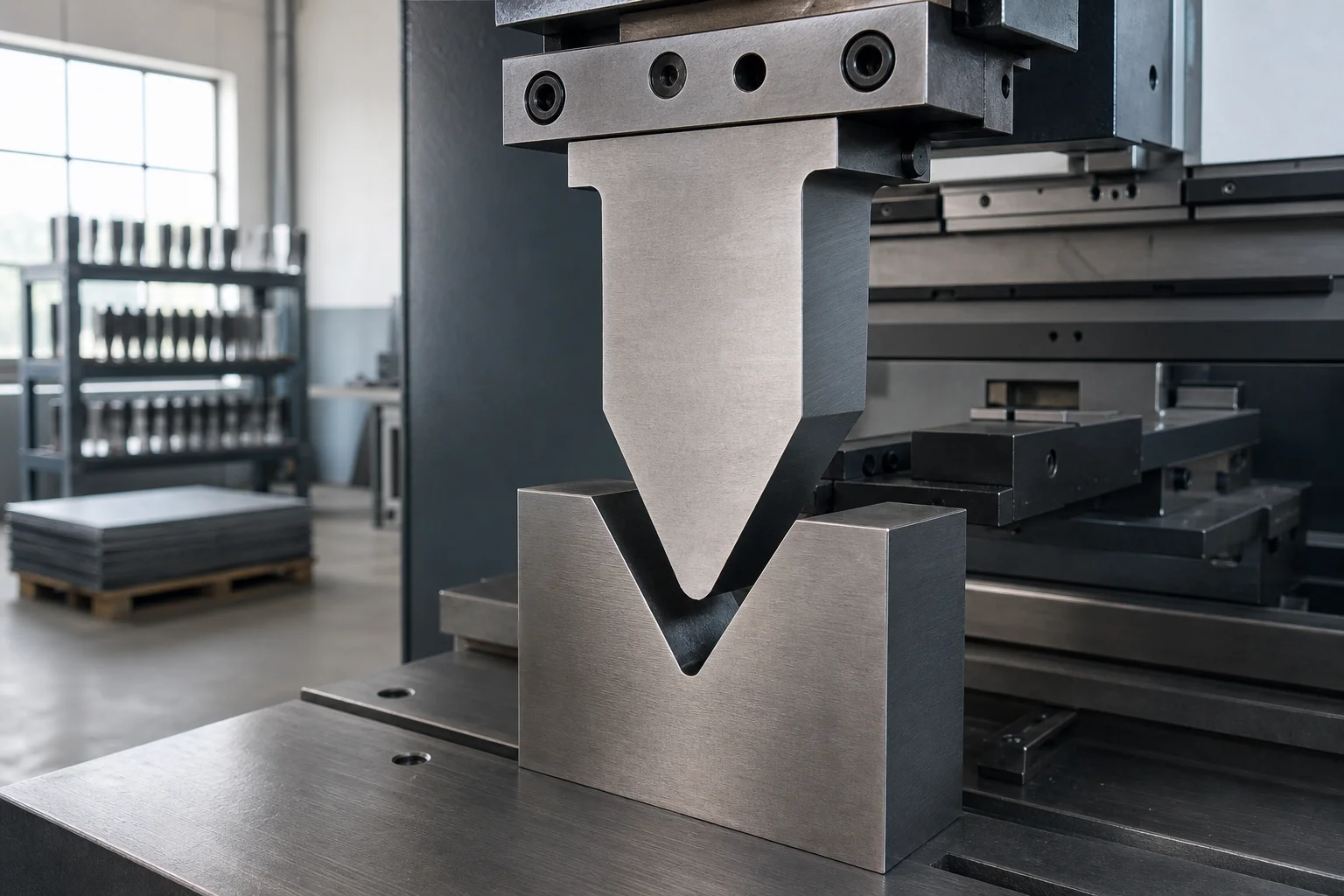
What “TYD-System Amada 85°” Actually Means
Three separate things are being described in that one product name, and each one affects whether the tool fits your machine.
The 85° included angle
An 85° punch tip is slightly sharper than the 90° bend it is usually asked to produce. In air bending the sheet springs back after the ram retracts, so the tool has to overbend the material to land on a true 90°. An 85° tip gives that overbend headroom without forcing you into a bottoming or coining setup. If you specifically need an 88° tip, several SKUs in this series have a listed 88° counterpart available on request — those are shown in the last column of the table below.
“TYD-System” is the tool range; “Amada” is the interface
TYD-System is the Tranyond tool family. The Amada reference describes the tang and seat geometry — the mounting interface that locates the punch in the holder. That interface is the single most important compatibility question, so check it against the holder actually bolted to your machine before ordering.
85° is not the same as 88°
Both appear in press brake tooling catalogues. The angle stamped on the tip is the included angle of the punch nose. Confirm which one your bend calculation assumes; the two are not interchangeable in a springback-sensitive job.
The Full 85° Punch Series: Verified Specifications
Every row below is a live Tranyond SKU. Capitalised prices are the current list price for the 835 mm length in USD; the 415 mm and sectionalized 800 mm variants are priced separately on each product page.
| SKU | Tip radius | Height (mm) | Max load (kN/m) | Material | L=835 mm price | 88° option |
|---|---|---|---|---|---|---|
| 10.170 | R0.6 mm | 66.74 | 350 | C45, tempered to 800–850 N/mm² | $275.84 | 10.176 |
| 11.151 | R0.8 mm | 104.5 | 500 | C45, 650–800 N/mm² | $454.33 | 11.147 |
| 11.200 | R0.8 mm | 66.5 | 1000 | C45, 650–800 N/mm² | $178.49 | 11.145 |
| 11.201 | R3 mm | 65.45 | 1000 | C45, 650–800 N/mm² | $178.49 | 11.101 |
| 11.230 | R0.8 mm | 105 | 1000 | C45, 650–800 N/mm² | $338.43 | 11.228 |
| 11.231 | R3 mm | 105 | 1000 | C45, 650–800 N/mm² | $338.43 | — |
| 11.232 | R0.8 mm | 135 | 1000 | C45, 650–800 N/mm² | $463.60 | 11.870 |
| 11.270 | R0.6 mm | 95 | 500 | 42CrMo4 | $449.69 | 11.260 |
| 11.650 | R0.8 mm | 104.5 | 500 | C45, tempered to 800–850 N/mm² | $509.96 | 10.504 |
| 11.660 | R0.8 mm | 89.58 | 600 | C45, 650–800 N/mm² | $380.15 | 11.146 |
| 11.670 | R0.8 mm | 145 | 600 | 42CrMo4 | $1316.62 | — |
| 11.820 | R0.6 mm | 115 | 200 | 42CrMo4 | $764.94 | — |
| 11.831 | R0.6 mm | 85.0 | 120 | 42CrMo4 | $683.81 | — |
| 11.835 | R0.8 mm | 120 | 500 | 42CrMo4 | $913.29 | 10.505 |
| 11.848 | R0.8 mm | 145 | 700 | C45, 650–800 N/mm² | $1091.78 | — |
| 11.849 | R0.8 mm | 165 | 600 | C45, 650–800 N/mm² | $1339.80 | — |
| 11.855 | R0.6 mm | 135 | 400 | 42CrMo4 | $598.04 | — |
| 11.861 | R0.6 mm | 100 | 500 | C45, tempered to 800–850 N/mm² | $407.97 | 10.262 |
| 11.863 | R3 mm | 88.5 | 600 | C45, 650–800 N/mm² | $380.15 | — |
| 11.865 | R0.8 mm | 89.7 | 500 | C45, tempered to 800–850 N/mm² | $489.10 | 10.502 |
| 11.866 | R3 mm | 103.5 | 500 | C45, 650–800 N/mm² | $454.33 | — |
| 11.869 | R0.8 mm | 105 | 450 | C45, 650–800 N/mm² | $931.84 | — |
How to read this table
- Tip radius drives the smallest inside bend radius you can produce, and how much the tool marks the material.
- Height is the figure that must agree with your clamping system. The series spans 65.45 mm to 165 mm — a 100 mm spread, which is the difference between one holder and another.
- Max load is a rating per metre of tool length, not per machine. It is the ceiling you must stay under for the material, thickness and die width in your job.
- Material is quoted exactly as published: C45 at 650–800 N/mm², C45 tempered to 800–850 N/mm², or 42CrMo4 on the deeper, narrower profiles.
Step 1 — Choose the Tip Radius Before Anything Else
The punch nose radius sets a floor on your inside bend radius: the finished inside radius cannot be smaller than the nose of the punch. In air bending, the inside radius you actually get is governed mainly by the die opening — roughly 16% of the die width for 60-KSI mild steel, the figure commonly referred to as the “20 percent rule” when bending 304 stainless.
That relationship produces three practical cases, and the series covers all three:
- R0.6 mm (10.170, 11.270, 11.820, 11.831, 11.855, 11.861) — the tightest noses in the range. Use them when the drawing calls for a small inside radius on thin material.
- R0.8 mm (11.151, 11.200, 11.230, 11.232, 11.650, 11.660, 11.670, 11.835, 11.848, 11.849, 11.865, 11.869) — the general-purpose group, and the widest choice of heights in the series.
- R3 mm (11.201, 11.231, 11.863, 11.866) — larger noses for thicker material, larger inside radii, and less risk of marking or creasing the surface.
The supplier’s own bending reference sets out the sharp / perfect / radius thresholds and the die-width formulas that connect them, and it is worth reading alongside this table if you are working out an inside radius from scratch.
Step 2 — Match the Height to Your Clamping System
A punch only works if its height puts the tip at the right closed height in the holder you own. Bottoming out or leaving the tip short both wreck the setup, and neither is fixable by adjusting the ram alone.
This is why the series carries so many heights rather than one. The 1000 kN/m high-load group alone runs at 65.45 mm (11.201), 66.5 mm (11.200), 105 mm (11.230 and 11.231), and 135 mm (11.232) — four different closed heights, one load rating. The taller profiles climb from 115 mm (11.820) to 165 mm (11.849).
Fixed-height tooling systems exist precisely to remove this variable: AMADA’s fixed-height AFH range, for example, keeps a consistent punch height so the laser safety device does not need re-adjusting between tool changes. If your shop runs a fixed-height philosophy, pick the SKUs whose height matches your system and ignore the rest of the series.
Step 3 — Check the Rated Load Against Your Required Tonnage
The kN/m figure is the part buyers most often ignore, and the part that most often destroys a punch. It is a capacity rating for the tool, per metre of length. Your bend has a required force per metre. If the requirement exceeds the rating, the tool deflects, deforms or fails — regardless of what the machine is capable of pushing.
The published industry formula for forming tonnage is:
Forming tonnage per foot = [(575 × material thickness²) / die width] × material factor × method factor
with thickness and die width in inches, material factor = (material KSI / 60), and method factor 1.0 for air forming or 5.0 for bottoming.
Worked example
Bending 3 mm mild steel (0.118 in, 60 KSI) in a 24 mm V-die (0.945 in) using air forming:
- 575 × 0.118² = 8.01
- 8.01 ÷ 0.945 = 8.49 US tons per foot
- Converting: approximately 25.3 tonnes-force per metre, or about 248 kN/m
Against that requirement: 11.831 (rated 120 kN/m) is overloaded and not suitable; 11.820 (200 kN/m) is also below the line; anything from the 350 kN/m group upward has margin, and the 1000 kN/m tools — 11.200, 11.201, 11.230, 11.231, 11.232 — carry roughly four times the load this job demands.
The corollary matters as much as the calculation: if your workload is light, the 120–200 kN/m tools are not “worse”, they are the narrow-profile tools built for delicate work. Match the rating to the job in both directions.
Step 4 — Pick Lengths: 835 mm, 415 mm or 800 mm Sectionalized
Every SKU in this series is offered in the same three configurations:
- L=835 mm — full-length tool for production bending.
- L=415 mm — half-length tool for shorter parts, typically the cheapest way into a given profile.
- L=800 mm sectionalized — 10 segments with horn extension left and right, for box and return-flange work where a solid tool would foul the part.
Price scales in a predictable way: 11.200 in 835 mm is $178.49, in 415 mm $106.63, and in 800 mm sectionalized $301.34. The sectionalized version costs more because it is ten separate precision segments rather than one bar.
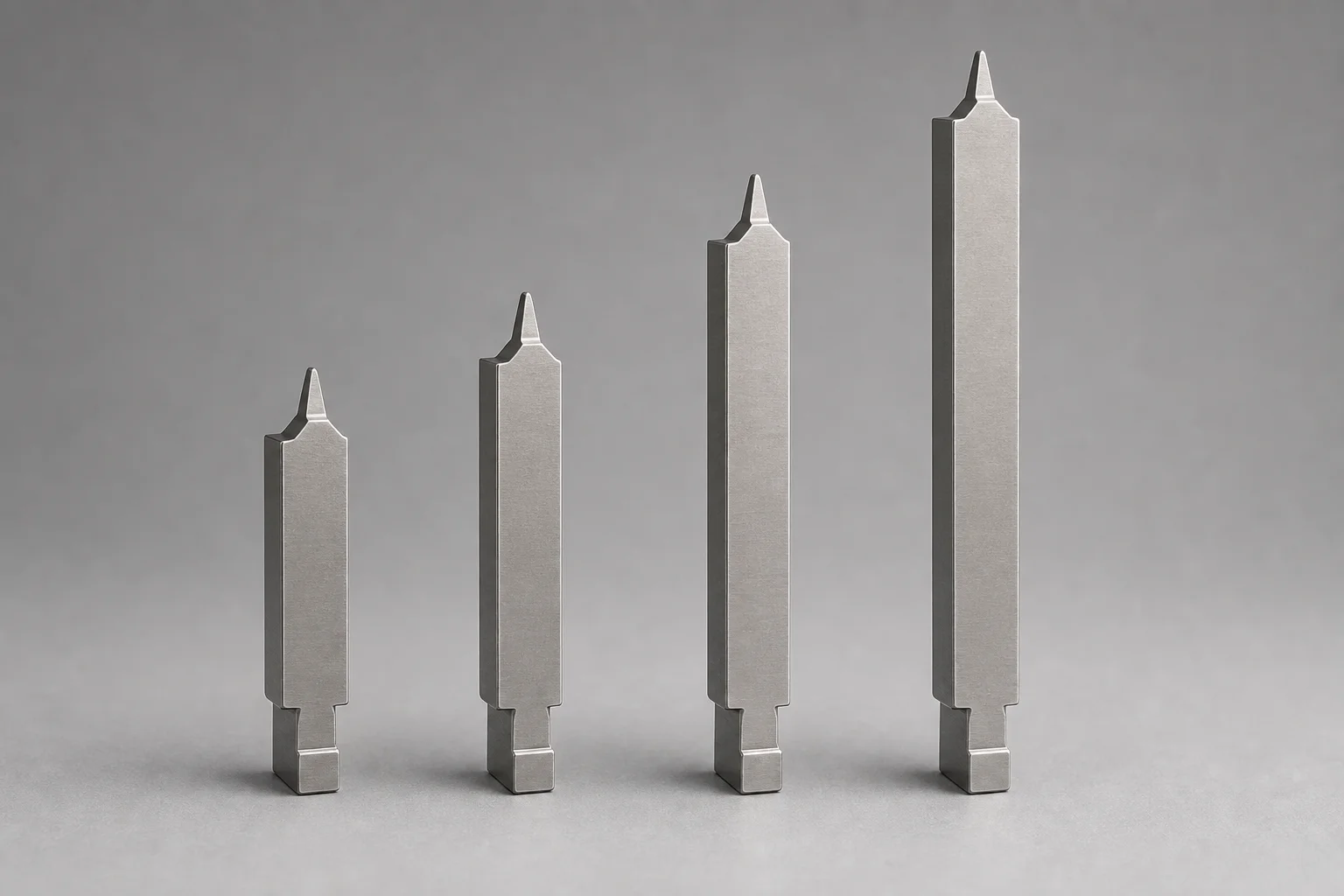
Material Grades: C45 and 42CrMo4
Two grades appear across the series, and the listing names them exactly:
- C45, 650–800 N/mm² — the majority of the range, including the entire 1000 kN/m group.
- C45, tempered to 800–850 N/mm² — used on 10.170, 11.650, 11.861 and 11.865.
- 42CrMo4 — a chromoly tooling steel used on the deeper and narrower profiles: 11.270, 11.670, 11.820, 11.831, 11.835 and 11.855.
Grade alone does not tell you whether a tool suits your job — heat treatment, grinding tolerance and the tip geometry all contribute. Confirm the exact grade and heat treatment on the data sheet for the SKU you intend to order rather than assuming two tools with the same rating are equivalent.
Pre-Order Compatibility Checklist
- Tang and seat profile — does the Amada-style interface match the holder on your machine?
- Height — does the published overall height match your clamping system’s closed height?
- Tip radius — is the nose radius equal to or smaller than the inside radius your drawing requires?
- Load rating — is your calculated force per metre comfortably below the kN/m rating?
- Length and sectionalization — does the part geometry clear a solid tool, or do you need the 800 mm sectionalized set?
- Angle — 85° for springback headroom, or an 88° counterpart if your setup calls for it?
- Guarding — verify point-of-operation guarding is in place before any trial bend; the general machine guarding requirements are set out in 29 CFR 1910.212.
Frequently Asked Questions
What is an 85° press brake punch used for?
Air bending steel and stainless sheet to a nominal 90° bend. The 85° tip is 5° sharper than the target bend, which provides the overbend needed to absorb springback without switching to bottoming or coining.
What tip radii are available in the TYD-System Amada 85° series?
Three: R0.6 mm (six SKUs), R0.8 mm (twelve SKUs) and R3 mm (four SKUs). R0.8 mm is the general-purpose option and carries the widest choice of heights.
How do I know whether a punch fits my Amada-style press brake?
Check the tang and seat profile against the holder fitted to your machine, then check the overall height. The series spans 65.45 mm to 165 mm, so height mismatch — not the interface — is the more common reason a nominally compatible tool will not work.
What does a 1000 kN/m rating mean?
It is the maximum bending force the tool is rated to carry per metre of its length. Compare it with the forming tonnage your job needs per metre — not with the tonnage rating of the press brake.
Can I order an 88° version instead of 85°?
For twelve SKUs an 88° counterpart is listed as available on request, for example 11.145 for 11.200 and 11.101 for 11.201. The full set is shown in the last column of the specification table above.
Which lengths do these punches come in?
835 mm, 415 mm, and an 800 mm sectionalized version made up of 10 segments with horn extension left and right.
What material are the punches made from?
The listings specify C45 at 650–800 N/mm², C45 tempered to 800–850 N/mm², or 42CrMo4 depending on the SKU. The material is stated for each tool in the specification table.
Is 11.200 the same as 11.201?
No. They share the same 1000 kN/m rating and the same price, but 11.200 has an R0.8 mm nose at 66.5 mm height while 11.201 has an R3 mm nose at 65.45 mm height. Different radius, different result on the part.
Sources
- AMADA America — Press Brake Tooling (tooling interface, fixed-height AFH systems, sectionalized profiles)
- The Fabricator — “Grand unifying theory of press brake bending: Part IV”, Steve Benson, 15 December 2015 (inside radius rules, die width formulas, forming tonnage formula)
- AMADA — AFH Fixed Height Tooling brochure (fixed-height tooling rationale)
- 29 CFR 1910.212 — General requirements for all machines (point-of-operation guarding, U.S. Department of Labor)
Specification figures in this article are taken from the Tranyond product listings for the SKUs named above. Prices are the USD list prices published on those listings at the time of writing.